


POSITIVE REINFORCEMENT IS THE ONLY WAY!
- Apr 13, 2021
- 4 min read
By Charlene Maxwell

Positive reinforcement is one of the most powerful tools to train your dog or puppy
When you were young, your parents would probably give you money or a gift when you got good marks. For most of us, the promise of that reward made us happy and made us want to do well. That’s positive reinforcement in a nutshell.
Our dogs don’t care about money or the latest video game, but they do care about praise – and food. Positive reinforcement training uses a reward like praise, food, and even toys for desired behaviours. It works because the reward makes them more likely to repeat the behaviour.
Using positive reinforcement to train your dog means you reward the behaviours you like and ignore those you don’t like.
WATCH YOUR TIMING
Correct timing is very important when using positive reinforcement training. The reward must occur immediately, or your puppy or dog may not associate it with the proper action. So, if you’ve asked your dog to sit but only give them the reward when they stand up again, your dog will think the reward was for getting up and not for sitting. What you need to do is ask your dog to sit, and the second their bum hits the floor, you reward. Your dog then knows exactly what behaviour they’re being rewarded for.
KEEP IT SIMPLE
Dogs understand words and not long drawn-out sentences. When teaching your dog to sit, don’t say, “Fluffy, can you be a good boy and sit down?” This is way too long a sentence, and you’re using the words “sit” and “down” in the same sentence, which is extremely confusing for a dog. Rather get your dog’s attention and say “sit”. You could incorporate a hand signal if you want, and as soon as your dog sits, you immediately reward and say, “Good boy/girl.” Always keep commands short and uncomplicated. The most commonly used and important commands to teach your dog are: “sit”, “stay”, “down” (lie down), “off”, “come”, “leave”, “stand”, “heel” (walk with me) and “watch” (look at me).
Make sure that everyone in your family uses the same commands so that your dog doesn’t get confused. You could type out a list of the commands you want to teach your dog and stick them up on your refrigerator to remind everyone.
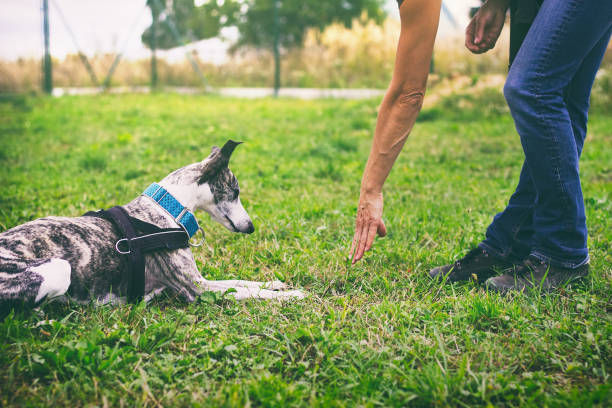
A GOOD TIME TO USE POSITIVE REINFORCEMENT
There are opportunities to use positive reinforcement training on your dog every day, so when you’re starting to train a puppy or dog, make sure that you have small treats on your person at all times. You can reward your puppy or dog when they “sit” for their meals, “stay” before charging out the door, go outside to do their business (“wee wee”) or “leave” a toy. Say “good dog/girl/boy” when they come to you when you call or when they do something you approve of.
It’s important, however, that you don’t use positive reinforcement to reward unwanted behaviours.
THE BEST FOOD REWARDS
Positive reinforcement can include food treats, a favourite toy, or even verbally praising and petting your dog. Since most dogs are highly food-motivated, food treats work especially well for training. Choose a treat that’s small and soft so that your dog can eat it quickly and look for more. Don’t give your dog something that’ll crumble and fall on the floor or that they have to chew for a while, as this defeats the object. Try different treats so that your dog doesn’t get bored with getting the same thing over and over again.
Every time you reward your dog with a treat, also give a verbal reward, also known as “praise”. You can say “good girl/boy/dog’s name” or even just “yes!”, then give the treat immediately after. In time, the verbal praise will come to mean just as much to your dog as the treat.

MOVING FORWARD
When your puppy or dog is learning a new behaviour, reward them every time they behave
correctly. This is called “continuous reinforcement”.
Once your dog has learned the behaviour reliably, you can practise “intermittent reinforcement”, which is when you continue with praise but gradually reduce the number of times you give your dog a treat. Don’t decrease the rewards too quickly, though, as this can undo all the work you’ve put into training your dog or puppy. Always praise your dog.
Cut down the times that your dog gets a reward, but don’t leave out the food reward all together. Your dog will soon learn that if they keep doing what you want, they’ll always get your praise and an occasional treat.
If you practise positive reinforcement training well, you won’t need to always carry around a bag of treats or a toy, as your dog will eventually do what’s expected for your verbal praise and attention because they’ll want to please you and they know that occasionally they’ll receive a treat as well.
HAVE FUN AND STRENGTHEN YOUR BOND
The key to positive reinforcement is consistency and patience. If you keep training sessions short and fun, positive reinforcement training can be a happy time for you and your dog. Positive reinforcement methods of training can help reinforce the bond you have with your dog.
Acknowledgements – www.humanesociety.org and www.positively.com


Comments